


I
The Best Modeler I've Played So Far
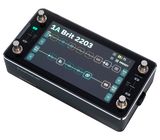
After about three months of active gigging and rehearsing with the Quad Cortex Mini, I can confidently recommend it. Before that, I used a Line 6 Helix for more than six years (playing 1–2 times a week), so I have a solid basis for comparison.
For me, the biggest difference isn't the number of models or features—every modeler requires some adaptation anyway—but the actual feel of playing. The Quad Cortex feels noticeably more natural and dynamic. The difference is especially apparent with lower-gain sounds, where it responds much better to picking dynamics and the guitar's volume control.
Another thing that impressed me is how consistently good it sounds across different monitoring systems. If I dial in a sound on my studio monitors, it translates well both to an active FRFR speaker and to the FX return of a tube amplifier, while still preserving the same playing feel. With the Helix, reverbs often sounded somewhat metallic through a tube amp's FX return, whereas the Cortex sounds clean, natural, and convincing. This is where I noticed the biggest improvement over the Helix.
The overall sound quality is outstanding, although that's probably what most people expect at this price point. The compact size is another big advantage—I can fit it on my Temple Audio Duo 17 pedalboard without any issues.
That said, it's important to keep in mind that four footswitches inevitably come with some limitations. After my experience with the Helix, where I had the footswitches replaced once under warranty and once after the warranty expired, I now prefer to step only on external controllers and keep the Cortex itself safe. For live use, I highly recommend adding an external MIDI controller. I use an Ampero Control together with two Ampero Switch units, giving me a total of eight external switches. With this setup, live operation is completely comfortable.
In short, this little box is fantastic. I'm a big fan of both the product and the entire Neural DSP team!
For me, the biggest difference isn't the number of models or features—every modeler requires some adaptation anyway—but the actual feel of playing. The Quad Cortex feels noticeably more natural and dynamic. The difference is especially apparent with lower-gain sounds, where it responds much better to picking dynamics and the guitar's volume control.
Another thing that impressed me is how consistently good it sounds across different monitoring systems. If I dial in a sound on my studio monitors, it translates well both to an active FRFR speaker and to the FX return of a tube amplifier, while still preserving the same playing feel. With the Helix, reverbs often sounded somewhat metallic through a tube amp's FX return, whereas the Cortex sounds clean, natural, and convincing. This is where I noticed the biggest improvement over the Helix.
The overall sound quality is outstanding, although that's probably what most people expect at this price point. The compact size is another big advantage—I can fit it on my Temple Audio Duo 17 pedalboard without any issues.
That said, it's important to keep in mind that four footswitches inevitably come with some limitations. After my experience with the Helix, where I had the footswitches replaced once under warranty and once after the warranty expired, I now prefer to step only on external controllers and keep the Cortex itself safe. For live use, I highly recommend adding an external MIDI controller. I use an Ampero Control together with two Ampero Switch units, giving me a total of eight external switches. With this setup, live operation is completely comfortable.
In short, this little box is fantastic. I'm a big fan of both the product and the entire Neural DSP team!
1
0
Ohlásit hodnocení